Sunday, September 5, 2021

the creature from the black lagoon is beautiful

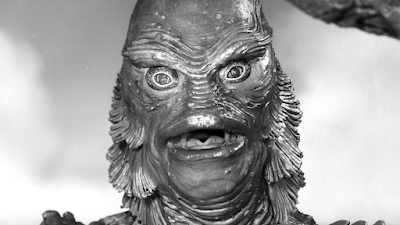
i watched the creature from the black lagoon last night & simply have to say... the creature from the black lagoon is beautiful. striking, even!!! from the right angle, she holds all the glistening grace available in this world. from the wrong angle she is menace. but this element is ever-imposed, a camera's insertion & insistence. & what is the camera if not another member of the boat's crew, ready to pilfer every last morsel of data from her world. hours after leaving the theater, i still feel her piercing jewel-ish eyes in my soul. i am haunted by her mouth gently prodding the water's surface. u tell me this isn't one BEAUTIFUL woman. don't lie to me when ur reading my blog!!!

she's beauty, she's grace

i guess the creature from the black lagoon being beautiful is kind of the conceit of the film the shape of water, which i watched about 25 minutes of once, desperate to understand why it had become the romance of the century. but it all makes sense--here is the most elegant of essences, the graceful swimmer who gently probes for understanding & ends all that she deems dangerous to the ebb and flow of her world. bring this bitch to an Amazon.com board meeting and let her loose!!! the shape of water checks out. i would date the creature from the black lagoon in a second; she lives a life of 0 to 100 integrity--all action, no talk.

the mask of the fish costume was created by a woman named milicent patrick who had spent a few years working in walt disney's ink & paint Sweatshops for Women before being hired by universal. she is often called the first women to work in special effects makeup, having assisted on several films prior to designing the creature's head. the studio sent her on a press tour to promote the film as a marvel hottie working in the man-dominated special effects world and the megalomaniacal boss of universal's makeup department got jealous and fired her. within this we find a story on par with that of the black lagoon--the total destruction of a minorly threatening presence mostly bolstered by ego & excess. get hollywood on the horn, we've got a story that'll really keep u up at night.

milicent works her magic

patrick's work on the costume was erased by her boss who eventually took credit but over the years a group of creature-gaga historians have resuscitated her legacy. in adapting what was once a book into this movie, someone made the creative decision for the creature to be human-sized instead of her novelized 30ft long, ship-sized state. she also became gendered (u cannot convince me this creature is a man, i simply won't have it) from having been hermaphroditic. in summoning a very human presence, patrick gives her the quiet and sweet mouth of a fish, which provokes some of the most beautiful scenes in the film. when she is held captive underwater after being tranquilized, she comes to in her cage with a still moment of quiet breaths. her lips come up for air as much as launch a line of inquiry. the growls imposed over her moments of attack seem not to belong to her--they're a part of something else that doesn't concern her. the world responding to itself, maybe.

for all the violent roars, the creature is much more likely to reach out with a relatively chaste hand. we rarely see her hands as destructive, only curious. in contrast to the harpoon-toting scientist gang, she is the most respectful examiner. there's something innocent about the way she's always tenderly reaching into a scene, grasping at whatever sensory knowledge lies before her fingertips. we almost always see the creature first as hand. i am imagining the opening bars of "come to my window" as she pulls herself up into my second-floor bedroom to await my return from work. is this the shape of water 2??? once again get hollywood on the horn.

don't u dare tell me this doesn't move u

one of the most iconic scenes in the film is when the creature mirrors the free and wild swimming of scientist kay from the depths below. kay is the sole woman trapped aboard this colonial pissing contest; she's an object bounced between her employer and her boyfriend. the creature sees a parallel in their operations. kay is able to enjoy the lagoon without taking something from it, without harvesting its soul. two gentle hands admiring what is novel. i watched this movie w/ the conviction that the creature was always showing up to save kay from the real horror--a ship full of 10 sweaty guys. if u watch it in its original form, the 3d element of this film gives a heightened importance to the dirt and grime plastered over each of these stinky duds. chest hair launches from the screen. aaaah!!!

the creature has a kind of perfect post-swim hair look. when she's forced on shore, she loses her total elegance but keeps this reminder of where she is meant to be. the swimming suit was inhabited by ricou browning whose work prior included choreographing synchronized underwater performances for pre-movie newsreels and working at tourist trap "mermaid shows" in weeki wachi, florida. he gave the creature her necessary poise, a real knowledge of her world and some sense of authority in the lagoon. i'm obsessed with her faraway eyes. rather than having a fish's comprehensive eyes-on-the-side-of-head (what is this term?) field of vision, the creature's stare is human--head on, confrontational! but with a softness in how her eyes never seem to pin u down. the actual creature suit held capacity to move the mouth and gills but not the eyes. for all the hell that breaks loose she still seems a little distant, removed. she would rather be anywhere else than on this ship or carrying this woman. she stares somewhere beyond the camera, a different reality on the horizon.

i watched the creature from the black lagoon in celebration of my friend andrew's birthday last night. he hooked it up with 3d glasses which always make things a little more fun and a little more nauseating. i couldn't have imagined watching this film any other way & am tremendously grateful to have spent some time w/ this belle of the swamp. happy birthday to andrew, who has never shot at me with a harpoon, only gently extended an olive branch hand thru the porthole of life's misery. 

Friday, August 6, 2021

visions: the war widow (1976)

ladies if ur husband has gone off to war and ur at home pacing the drawing room simply unable to recall what his face looks like...u might be a homosexual. if its the 1910s & ur man is sending u beefy letters from exotic european locales & u cannot put down ur needlepoint for five minutes 2 delve in....i have 2 break this news: u may b battin for the wrong team. 

amy sits at the piano, trying to remember if she has a husband or not 

"the war widow" (1976) might possibly be the originator of a handful of lesbian movie tropes: the artist lover who "needs" the object of her desire to sit for a portrait, the flirtatious but far-too-long staredown (more to come on this), the HANDS shot, the scene where an ex or friend establishes some kind of gay milieu that throws the newly-realized queer into a world they may not be ready for just yet.  "the war widow" is an episode of visions, an ambitious late-seventies tv series of standalone dramas featuring not necessarily "tough topics" but new vantage points w radical impulses. ucla has been showing episodes of visions as a part of their virtual programming, starting with a brilliant alexis deveaux/maya angelou episode a few months back ("tapestry") that worked thru the story of a young black woman studying law and navigating dating and societal expectations w/ brilliant avant-garde theatrics (incredible scenes involving her childhood congregation haunting her bathroom) and sharp writing. clocking in at the perfect runtime of 90 minutes, each ep is kinda like an emotional smoothie—a steady jumble, if u will—and more closely resembles a play than a film, taking cues and casts from the theater community.  before i go any further, i will say that a generous genius has made "the war widow" available to watch on youtube.

the kind of font that makes u a homosexual


this episode was directed by paul bogart and written by harvey perr, the latter joining actress frances lee mccain (jennie) & historian/filmmaker jenni olson for a discussion after the film. perr shared that this story was written from his own experiences as gay man discovering his sexuality and ending a marriage and that bogart was working through similar things around the time of filming. the newness of this emotional realization is perhaps the sweet undercurrent dutifully joining naïve-but-pure sentimentality with a vibrant (but admittedly unrealistic lol) kind of hope. "the war widow" chronicles a lonely wife and mother, amy, who meets a mysterious photographer, jennie, one day while she's having a crisis in a tearoom. with amy's husband away in wwi and her mother conveniently always watching her daughter at their very plush estate, amy and jennie get to know each other and slowly fall in love. it's something altogether cute and wild for an hour of tv drama during a still-hostile time for queer women. (during the discussion, olson resurrects this new york times article that contextualizes how unique & revelatory this play was.)


most of the contemporary impulse to make lesbian period pieces is just the easy plot—the will-they, won't-they given a weight that has no parallel in modern times. women's livelihoods were inextricable from their family units and to be queer was always to step out of the neat and secure system of family and into a wilderness filled with (in the most optimistic case) people like jennie's friend who shows up in a bonkers mustard number at the eleventh hour to wag her homosexuality around the room like a matador's cape. to be caught between a rock and a tidal wave of floam... anyway, we have entered into a moment in contemporary cinema where (mostly out of lazy writing) many woman-woman relationships come in2 fruition via looks and whispers in the parlor. "the war widow" was ahead of its time!!! it didn't need the drama as much as the situation—a reason for these women to seek each other out, a catalyst for difference. in the 70s, a period piece had the potential to evoke a time before the lavender scare gave queer relationships state-sanctioned repulsion and a DSM listing. the viewer is invited to imagine some parallel unknown that lie ahead, where one's self would be the only barrier to love.


trying 2 find this outfit let me know if u have any leads


"the war widow" is filled w/ incinerating glances and some of the shots leave us helpless recipients of the singe. & when i say glances im talkin looks of INVASIVE PIERCING DESIRE. frances lee mccain was born 2 stare. there's, of course, great tension between what we get to see and what we wonder about but even more than the nights of passion we want to view the photos that the women hold in intimate dissection. we want to see what jennie sees w/ those laser-focused eyes. for amy, whose interior life has corroded with idleness and isolation, its not the object-creation and authoritative power of jennie's photography career that piques her interest but seemingly the small community it has allowed jennie to cultivate. a talented pianist in her own right, for amy to have an audience would give her a real sense of creation—no proper music made in a void. “ive never had a friend before; i just realized that this afternoon,” amy says at one point, finding some simple solace in company—real companionship, regardless of romance and devoid of the toxic baggage of family.


jennie's stares make up about 45 minutes of the film


visions seems to have at least one small-but-bold compositional experiment in each episode. a strange standout scene (for perhaps its length and desire to reverse the aforementioned gaze) is a montage of photos shown from jennie's portrait session with amy and amy's mother and child. this slideshow is quite long considering the general economy of the episode and is immediately juxtaposed with a lengthy scene of amy playing piano. ultimately it's a conversation of sorts in a corny but soulful way—an intermission with purpose. the soundtrack for this episode was done by mark snow whose most famous project is the x-files and i will say—as an unfortunately studied x-files fanatic—the man is a saccharine tyrant with a loose emotional compass and he really does not change a wink in the 20 years between these projects. a space ship really is a hotel lobby when mark snow has his say.


with visions, i always anticipate melodrama, but am met with sincerity. "the war widow" is a truly charming story and we get so many great moments from amy as she comes into certainty about her needs. amy & jennie, lying on the floor in a ripped-from-your-daydreams slumber party type of way, get to know each other after such a silent first few acts and amy says, "tell me the color of wheat" in that perfectly stupid way you'll say just about anything when you're too desperate to know someone. much earlier, amy says, "i think i'd die if there wasn't some mystery in all of us," almost to explain why the exposition has been so quiet and it truly satisfies. i also love amy's "i'm ashamed because i feel such little shame with you" and when she turns to her mother and says "the thing we had in common was neither one of us could feel anything." so much to expose how her depression has idled a perceptive soul. i love to watch a character smack someone across the face w/ their own vulnerability!!! this play wants us to know amy isn't naive, she understands how the world works and her decision at the end of the episode is made with full knowledge of its consequences. one final shout out to the cracked teacup extended metaphor that had me weary and teary.


the hands...the tulle....what VISION


i can't believe this was only the second episode of visions; something totally audacious to announce the series' intention to do as it pleased, and with heaps of empathy, force, and....dare i say.....vision. ultimately, "the war woman" is a totally engrossing play about not just lesbianism but women and all of the relationships and obligations they fall into. (i didn't even get into amy's relationship with her mother!!!) visions makes you hungry for what TV could have looked like in the seventies, energized by radical writers, ambitious in its record of truthful but compelling history. "the war widow" especially inviting us to look outside the itchy american family & reach 4 real desire w/ a confident zeal.

Sunday, March 14, 2021

monster (2003)


i was stricken last night w/ the impulse to watch monster, a movie that is difficult & deeply upsetting but perversely filled w/ such genuine moments of tenderness. if you turn it off after the first half-hour, monster is one of the most well made american lesbian romance movies--hot, fussy, & truly romantic. most lesbian films are hellbent on turning romance into trauma, but this one's driving force might be the desire to turn trauma into romance. it wants everything in the world to gain legibility through love or its lack & doesn't waste too much time on queer suffering--it's collateral to anyone who's been an outcast long enough. at one point charlize theron as aileen pins her girlfriend selby (christina ricci) against a wall outside the roller rink in the kind of desperate passion most other movies could never conjure up. just two (hot) ugly women, blissfully swapping spit while townies jeer. the real joke will always b on the uninitiated--those who aren't getting their ass grabbed in the moonlight after a lifetime of anticipation.

there's a profound hotness to charlize theron as a confident, loving provider with dumpy acid wash jeans and hair sprayed into an eternal wind tunnel pomp. she has a real butch aura. the makeup artist kind of went out of her way to make charlize more worn & alien than aileen ever could have been--face & body spray painted w/ freckles, eyebrows half-shaved. the night before this, i watched the uhhhh cinematic classic the devil wears prada, in which the consistent butt of the joke is how fat & ugly size-six anne hathaway (dressed in an ill fitting sweater like any other woman in 2006) is. this film really goes for it w/ "ugly," but instead of being told again & again how ugly aileen is, we get the astonished awe of her girlfriend. "the guys must be lining up for you," selby tells aileen with heart eyes. it's true to the world--not hollywood--where someone's face holds everything we love about them, a little mirror of adoration.

im obsessed with aileen's hulking presence in all things but especially on the roller rink floor, taking lead in a couples skate to "don't stop believing," & initiating a kiss w/ burning eye contact even tho it's 1989 & the small-town rumor mill is a supporting character. in one scene she emerges from around the bend of a go-kart track w/ this brilliant here comes your man glee. casting christina ricci for this fictionalized version of wuornos's girlfriend was a choice & results in this utter cavern of space between the two of them--aileen intensely hunching to meet selby's gaze. another level of hot awkwardness. i want to meet the person who did this. there is so much pain & suffering in this film but the parts that are sweet really sing.


if i'm allowed to continue to treat this movie as a lesbian romance, i was drawn to the journey selby goes through, gaining confidence from aileen & working through a young soft butch's wardrobe--moving from the sensible christian layering of her youth to dickies & doc martens. she tries out a beanie, even, which unfortunately later re-appears in her wanted sketch in a way that really feels like a cruel joke about lesbian fashion (who wrote that into the movie??? i demand to know). she is naive & then she's not. lesbian films love age-gaps because they provide a legible power structure (pls email me at gilligcassandra at gmail dot com for my endless thoughts on this very topic) but monster actually does a good job of capturing the weird element of a love that hits at both the most necessary & inopportune time--lovers drifting apart from the very first moment but moving in line all the same.

as you might b able to tell, there are 20 minutes of monster that i find soul-crushingly romantic & maybe it's just because you never get to see two women have a dorky, unpolished, & busted way of loving each other outside of yr own dorky, unpolished, & busted life. it feels insane that this is the package (serial murder, inconceivable trauma) this type of connection must live inside. i have this dream to do supercuts of all the lesbian films that end w/ great suffering & instead give us the half hour of loving bliss we deserve. i think a lot about the first part of the film freeheld (a sweet story of two women who meet at intramural sports practice) & turning it off the second julianne moore starts to show signs of illness, pretending she's just pulled something & she'll sort it out in water aerobics. or a version of carol where there's no private investigator trailing them at the motel, just another few weeks of vacation to look forward to. what if these movies left us w/ our own imaginations for a while. two dykes in a movie can't even go grocery shopping w/o incident. one day i'll go to the theater & be so bored i finally feel alive.

there's a lot i could say about this movie that i don't have necessary space to cover (nor the right drive or authority). it is a difficult film to watch. i don’t know what to make of this movie’s impulse to root wuornos’s actions so heavily in the romance narrative—does it suggest that harm is not enough of a trigger? i appreciate monster’s refusal to glamorize or editorialize violence--it is matter of fact. i love the steady presence of florida & its frantic but boring backdrop. the director seems to have a lot of integrity & respect for aileen's story. the oscars are a load of crock but it really does seem like if anyone deserved a truckload of trophies dropped in their front yard in 2003, it was charlize theron. toward the end of the movie, aileen's whole body is otherworldly as she trembles at the bus station contemplating the future. the story's fissure lives inside her. there's never a moment that you remember it's charlize--u have no chance to.

my ability to dissect this movie as entertainment is not w/o a complication. i had lately been thinking a lot about aileen wuornos after the january death of lisa marie montgomery--two women who experienced unthinkable childhood trauma and were murdered by a government that holds death as a reasonable alternative to care. i am uncomfortable with the economy of true crime (wuornos herself condemnatory of its predatory presence), but monster operates at least with a drive toward humanizing someone who was thoroughly violated and exploited by the press. i can't speak with authority on aileen's life but her death and the murders she committed weren't inevitable & are testaments to the violence of a society that operates without safety nets. my hope is aileen did truly get the chance to experience some moment of love--of care--no matter what preceded or followed.

Tuesday, February 9, 2021

the poetry foundation, eli lilly, & the PIC

it is hard to explain the poetry foundation's cultural power.  it's an institution that is both deeply mistrusted and the only of its kind.  online, it's a free and extensive database of poetry that also bears notable omissions in the same white supremacist xenophobic idea of a canon as most american arts and educational institutions.  as a publication, poetry is the kind of magazine many poets throw away upon receiving while secretly daydreaming about appearing in its pages (if for no reason other than its payment at $300/poem).  backed by an unprecedented $200 million donation from ruth lilly--the heir to eli lilly pharmaceuticals--in the early 00s, the foundation has shifted in cultural identity over the past ten years, rolling with a neoliberal subsumption of radical poetics and including a more diverse roster of published poets and awardees.  the end result is a magazine now unrecognizable from issues published just a few years earlier in its hundred-plus year tenure.  the current backlash against the foundation is due to its inclusion of poems in its february 2021 incarcerated poets issue by someone who was incarcerated for child pornography possession and circulation and has a professional history of sexual harassment and violence.  many have already dissected the carceral feminist calls to check the crimes of incarcerated people prior to publication but as someone who is interested in the broader discussion around whether or not poetry magazine could be a site for discussing and upholding abolitionist ideas, i found myself thinking first about eli lilly's place in the prison industrial complex.

ruth lilly's massive donation of eli lilly pharmaceuticals stock to the poetry foundation grew to be valued at about $200 million in 2010.  this was not too long after eli lilly received what the US DOJ then deemed the "largest individual corporate criminal fine in history" for aggressively mismarketing its drug zyprexa for unapproved uses.  to take zyprexa as just one example of the widespread and lethal impact eli lilly has had on incarcerated individuals, here's one lawsuit from a prisoner who jailers forced to take zyprexa even after he asserted that it caused him to develop diabetes (a commonly reported side-effect of the drug & important to note eli lilly's status as a significant producer of insulin--here's their Twitter, "we're all diabetes all the time!").  another article, in examining the "fear"-based overprescription of psychotropic drugs, recounts a prisoner who committed suicide with double the maximum prescription of zyprexa in his system.  

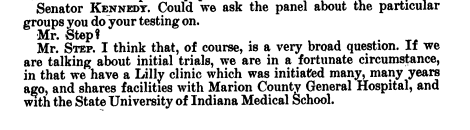
like most pharmaceutical companies, eli lilly was drug testing without oversight on prisoners prior to the FDA intervening in the 70s.  in hearings on "preclinical and clinical testing by the pharmaceutical industry" in 1975, eugene step, then-president of eli lilly, responds to questioning about their practices (381-382):


step emphasizes that the testing is done in lilly's own facilities, as if a facility with no oversight controlled by a pharmaceutical company was a more neutral or harmless place than the prison itself.  even with the development of regulations in 1975 and a general shift toward private sector testing, the same racist classist dehumanization that enabled such a rapid expansion of drug testing on prisoners in the first place is what drives and enables current overmedicalization in all carceral facilities.  ultimately, both operate toward the same end--profit maximization at the expense of people held against their will.

in the 50s & 60s, the cia contracted eli lilly to manufacture lsd for mk ultra.  the late 80s found eli lilly partnering with napalm-producer dow chemicals for a toxic agricultural joint venture.  here's eli lilly ceasing HIV testing in 1994 (the year AIDS becomes the leading cause of death for americans ages 25-44) because they no longer had a "competitive advantage" in producing treatments.  these, however, are sensational moments in a long and ceaseless history of pharmaceutical industry violence that extends far beyond the US & often as a result of US war & imperialism abroad.

in 2010, when ruth lilly's donation was valued at $200 million for the poetry foundation, the annual revenue of eli lilly was over $23 billion.  in an article in the chicago tribune in 2011, as the poetry foundation looked toward the opening of its building  john barr (pofo president 2004-2013) remarks, "...the grand experiment here was to throw money into this art form that had no history of making money and see if poetry would be OK at the end of the day." as u can see the sheer power & radical potential of this art form is not lost on john barr, former managing director at morgan stanley.

operating with a stipulation that only 4.5-5.5% of their net assets can be expended a year to account for inflation & maintain the trust, the poetry foundation's most recent audited financial statement on their website shows investments (which they are not transparent about) grew their assets by about 12% which is more than enough to safeguard against inflation.  poetry magazine & their website are essentially a cheap front for this investment-bolstered money hoard that is always going to prioritize its own financial security over any kind of broader community initiatives because it is literally written into the function of the foundation.  things like this call for the poetry foundation to donate $5 million to poets at the onset of the coronavirus pandemic thus are impossible for the foundation to fulfill even though it would be the mechanism by which it contributes to its mission to "raise poetry to a more visible and influential position in our culture."  accompanied by lack of concrete aid and during a crisis that is significantly more lethal for people of color, disabled people, and poor people, this ideology prioritizes and sustains a white ableist upper class poetics.  anyway, here are some poems of protest, resistance and empowerment from the poetry foundation in case you're having trouble paying medical bills.

part of what the foundation does in forcing its money to only go through its own programming channels is to not make a presence for poetry in culture but for Poetry in culture--to establish itself as the hegemonic voice for poetry. while many smaller magazines and presses will inevitably cease publication after the devastating impact of the pandemic, poetry magazine--which operates at a loss for the foundation every year--holds strong backed by the safe-guarded endowment.  instead of sustaining other parts of the literary community, the foundation absorbs them into things like an incarcerated poets special issue, another stop on a long history in capitalizing off of diversity and marginalized communities (it was less than a year ago poets were attacking the foundation for its spineless and empty statement on the George Floyd protests) while functionally silencing them by distributing wealth only in the form of "educational programs" and large monetary windfalls to a select few.

there's something to consider, too, in the way that only investing in its own programs keeps the eli lilly brand name alive & redeemed.  the cornerstones of the poetry foundation's lottery system are the ruth lilly prize ($100k to an established poet) and the ruth lilly and dorothy sargeant rosenberg prizes ($25k to a poet under the age of 31), both of which become yearly topical cesspools for infighting amongst poets who--to once again return to that lovely statement by big bozo john barr--have no history of making any sort of money with their art.  the foundation's greatest community contribution might be a kind of quarterly injection of bitterness, contention, & controversy into the poetry community that keeps it distracted from addressing the larger systemic issues of this foundation's very existence.  that said, feel free to drop ur fave bigoted poetry foundation microscandal in the comments below.

the actual ambitions & functionality of the poetry foundation were made very clear in 2011 when it opened a $22 million glass headquarters in a wealthy & out of the way part of chicago.  it was to be a center for the elevation and appreciation of poetry--a poetry library open exclusively during working hours that held patrolling security guards, volumes of poetry you could not check out, and wine & cheese affairs to celebrate a series of distinguished white visiting poets whose work hit like an ambien after a rough day of insider trading.  at one of the first events in the space, a young white poet was arrested for "causing a scene" during a reading.  this account details how representatives from the foundation showed up at the trial to ensure prosecution.  i am reminded again of the foundation's mission statement--all of the things it says about sustaining poetry, without ever saying a word about sustaining poets.

in all of this the poetry foundation carries out the greatest ambition of eli lilly--to protect & grow its assets at the expense of anything that might be deemed a community & to use philanthropy as a shield for wealth built on the misfortune and exploitation of the rest of the world.  as pharmaceuticals save the world so does poetry!  as long as hundreds of millions sit in the investments of the poetry foundation, the only poetry i want 2 read is the reporting on our bank heist--the greatest love poem of all.

p.s. im deeply indebted in thought 2 my partner in poetry crimes cean & gratitude also 2 timmy, mahroh, & yuni of my reading group for sharing thoughts.  INCITE's book on the nonprofit industrial complex has greatly informed how i understand the way art money flows.

Monday, December 14, 2020

broken windows theory & the sale of "safety"

i'm trying to do a better job of recording my thoughts as i read, so hopefully this high traffic, much lusted after blog will return 2 some kind of wack fervor.  yesterday i spent a good chunk of time reading through the first portion of essays in Policing the Planet, a book that examines the broader impact of broken windows style policing.  i first came into contact with this methodology when i was a college writing tutor for a class that read malcolm gladwell's "broken windows theory." in the essay, gladwell, whose neoliberal pop sociology is legitimately shocking to read now, confidently asserts that broken windows policing accounts for the decrease in violent crime in 90s nyc.  i absolutely refuse to fully revisit this essay but i remember a particularly infuriating section where--using the logic of broken windows policing--the new head of the transit authority bucks the trend of going after "violent criminals" in favor of cracking down on fare jumpers.  in the process, countless young people enter into the criminal system for a simple act of poverty or teen rebellion.  the head of transit is celebrated for making the system of arresting young fare beaters at a faster rate than ever and contributing to the ceaseless proliferation & substantiation of transit policing.

to get a fuller picture of the reality of broken windows policing, i include Robin D.G. Kelley's definition in the first section of Policing the Planet.  he writes:

"First elaborated in a 1982 essay by George L. Kelling and James Q. Wilson, "broken windows" placed the blame for urban decay on the social values and behaviors of poor, primarily Black people. It argued that criminals flourished in deteriorating, disorderly neighborhoods, and that disrespect for one's community led to disrespect for authority and the law. As long as ghetto residents lacked concern for the condition of their neighborhoods, crime would run rampant; small infractions would become gateways to violent crime. Ignoring the structural factors that suppressed home values, perpetuated health and environmental catastrophes, and divested neighborhoods of essential services, jobs, government programs, and legal protections, broken windows theory blamed culture and immorality for crime and, in turn, poverty." (25)

Kelley's essay "Thug Nation" had so many thought-provoking moments for me.  the first was the assertion that criminal justice system expansion was not just the product of "a sharp right wing turn" post WWII but also a part of a liberal wave of protecting African Americans from, "mob violence, to quell urban rebellions, and to address what were perceived as rising crime rates following the triumph of desegregation" (21).  we see this same relationship between myopic liberal "good will" and unintended (depending on how you look at it) carceral consequences in Christina B. Hanhardt's essay "Broken Windows at Blue's" where she outlines hate crime legislation intended to protect LGBTQ+ people, part of the same pre-packaged idea of safety sold to rich white NYCers (straight & gay alike) in gladwell's essay.  all fueled by development revenue, of course.  as long as safety is defined & implemented by the state, it remains something as fatal to marginalized people as the interpersonal violence it forces & inspires.  Hanhardt ends her essay on a similar note: "the promises of solidarity offer much more than those of safety, and provide a collective alternative to solutions defined within rather than against the market" (61). a beautiful reminder that solidarity is an active, engaged process that finds its pulse in the margins--that our power will flourish in the spaces capital has long since abandoned.

Kelley uses the phrase "broken bodies policing" to talk about the fundamentally antiBlack police state & the meager differences between the way police officers see Black & brown folks vs they way they see the more frequently marginalized & overpoliced communities they exist in.  marginalized/overpoliced people are seen as products of their communities & neighborhoods except when it comes to individual criminality. broken windows policing asserts that an environment creates crime but the culprit is an individual then it refuses to put money toward what could fundamentally improve the community writ large.  policing logic in these scenarios is such that it simply points to its own actions in communities as evidence of both "crime" (a creation of policing itself) and "efficacy" (departments monitor & create their own stats) & gives no consideration to the actual ripples these practices have.  everything is so overwhelmingly circuitous.  broken windows policing opens up a self-fulfilling prophecy, like any other targeted tactic of policing.  a concentration of poorly trained, armed agents of "safety" with quotas and militant mindset are themselves the thing ruining a community & their presence & its necessary "success" only calls in more--more officers, more armaments, more arrests & violence.

i am thinking through the way criminalizing the person results in the creation of queer identity, as Christina Hanhardt begins to parse out in her article and as i've long thought about in my ongoing attempts to understand the pathologization/criminalization of lesbian existence in the 50s.  the way lesbianism is made REAL first through the purview of the state--how it is made medically diagnosable & legally incriminating.  i think, too, perhaps the only identity category to move in & out of legality in such a clear-cut way is gay/lesbian.  or maybe this example is just more available to me as someone who begrudgingly holds (& drops?) it.  i love when Hanhardt cites Times Square being called a place of "sin & decay."  i hope 2 exist in this world as such, a grand site of sin & decay--to exist in & toward ruin.

Hanhardt posits that in striving to become a community of "normal" people, white rich gays defined themselves against other functionally criminalized minorities (Black/brown folks, the poor, those w/ health issues) to prove their inherent "goodness" & normalcy.  this, though, is a product of social order & organization & the fulfillment of the state's initial labelling of lgbtq+ folks as a criminal "other."  the project realizes its ultimate goal when queers are able to act w/ the best interests of the state--to become productive employees, to raise children, create legible family unites, produce capital, pay taxes, & bolster gentrification efforts.  Hanhardt writes, "in many of these campaigns in recent years, activists have shown how the regulation of behavior deemed to be non-normative can be tightly entwined with real estate interests," going on to highlight the deaths of Dontre Hamilton, Akai Gurley, and Eric Garner.  she continues, "the real threats are not those individuals whose lives are considered to be at a distance from dominant 'norms,'"  quoting Cara Page (Audre Lorde Project) and Krystal Portalatin (FIERCE):

"[they are] when banks are allowed to engage in predatory practices that target communities of color and force groups to remain in poverty; when Detroit can declare bankruptcy on a city of mostly black communities and then take away basic rights such as water; when corporations are allowed to abuse other countries and depress US economies; when the US military continues to back and support Israel's oppression of Palestinian people and land" (60)

in a punitive and carceral world, normalcy means violence. thinking alongside Hanhardt, i have so many questions about the way my queerness has been "sold" to me.  how my desire & position have been created outside of any desire & position i might hold within.  in thinking about broken windows policing, i still cannot get over the transparency its name offers in the priorities of policing.  when private property is held in such regard that its disrepair, its brokenness, is the only root cause the police state is willing to acknowledge for any of society's struggles.  & while we expect the police to deny the reality of their impact on communities, it is more perplexing then that folks like malcolm gladwell might actually buy into this logic as well.  that to some a broken window might be seen as more of a call for harmdoing than a police officer drawing their gun.  that the end of all harm could ever be a single arrest for a skipped fare instead of asking why there are monetary limitations on how we move through the world.  i am looking forward to continuing to move through this book & reading more by Hanhardt & Kelley.

Sunday, August 30, 2020

my beautiful laundrette (1985) & love island (US, s2e1; 2020)

sometimes i get in a mood where i just wanna suck down a movie & have no thoughts about it & this mood might be labeled depression but it is a kind of wasteful luxury, too, to just pop in & out of a different world. a disassociative pleasure amidst everything that's been going on.  alas after many months of this exact approach to all things, i am back to my thinkin man's blog...may the sweet waters of my words touch your lips like the first rainfall after a ten year drought.

last night i marathoned two complementary masterpieces--my beautiful laundrette & the first episode of the newest season of love island.  yes, two sides of the same coin.  my beautiful laundrette is literally about a beautiful laundrette in a way that i could not have anticipated.  even the soundtrack is some sort of menacing sudsy synthpop thing that sounds like margaret thatcher peering out from behind an overflowing washer. a weird sinister subtext for a movie that presents moments of violence w/ a cavalier attitude & moments of joy as the most natural form of resolution. it's an out of touch optimism that wrenches itself out of reality 2 make room for bliss. viewers are moved between somewhat heavy handed scenes about race (South Asian diasporic tension meets fash 80s white nationalism & something very British at that) and heavier handed scenes about capitalism but ultimately, everything returns to the laundrette--its beauty, its grace, its huge and unnecessary neon sign. u can disappear in this perfect laundromat, it seems to say. 

the plot of this film at one point becomes that two gay men have spent too much money renovating a laundrette and have to figure out how to pay it back (lol! classic!! we love it).  this conflict resolves very quickly, however, and we return to the central tensions of difference--the three-pronged romeo & juliet scenario that is so impossible neither party looks to place the label "love" on what they're feeling. for both men, the laundrette is a ticket out of the middle class that requires 24/7 vigilance (& direct acts of violent oppression, too, we see in Johnny kicking the man asleep on one of the benches). it's like any other act of existing in a higher bracket of privilege than society is ready to afford you.  i guess the primary way of reading queerness in this film is that it's the only thing that refuses to reify the nation-state & all of its socioeconomic boundaries, but there's something to be said abt how the coupling inside of queerness creates a space to uphold and build upon these ideals anyway. but i'm not goin in to that folks im just here to talk about a movie

love in this film--like a lot of its other crimes--is casual, uncommented upon. the desire is a little muted. it was strange to watch both this and the handmaiden this week--two movies w/ queer characters that don't depend on the push & pull of will-they-wont-they touches & glances. there are a few great moments of stolen kisses--when Johnny licks Omar's neck secretly in front of his skinhead friends or when the two hold hands before departing a party under the guise of bro-y connection. there's a lot of queer proximity throughout the film, part of it being all of the masculine posturing in Omar's father & uncles taking the form of sexual bragging.  but ultimately there is a loudness to everything but the sex in this movie. the first kiss is sudden and confusing for viewers but so is desire, i suppose, especially when it operates against all of the boundaries of the world

we're told Omar's father is a socialist but he's mostly just an asshole with ptsd and alcoholism.  the politics of characters are all over the place--pretty indecipherable.  everyone's doped out--all bombast & out of character one second and quiet the next.  tonally, it's hard to know what this movie wanted me to feel and maybe that's the point.  it's a world w/ no good options.  we learn that love is either impossible or, simply put, transactional financial security.  that hate is a more vibrant unifier and agent of change.  that homosexuality isn't even enough of a consideration to be named or spoken of.  that laundrettes are hard to run and seem like low return financial ventures yet Omar's trying to get more of them???  the more Omar works on the laundromat, the more he becomes entrenched in and indebted to the ideals of his family.  & as the laundromat is the thin veneer under which he may reasonably spend time w/ his lover (all sex becoming workplace tangential), these modes & ideals dictate how he speaks to Johnny.  the movie closes abruptly (only 90 minutes), with another tonal shift letting us know everything will be ok but as long as the joy Johnny & Omar experience together happens inside the fucked microcosm of the laundrette, Margaret Thatcher wins.  may my 2 cents reign w/ the same ignorant authority.

i finished my beautiful laundrette thirsty for more TV & thought it finally time to put on the newest season of love island.  my beloved friend sondy's coworker will be appearing at some point during the season, so i am committed to supporting her in this trying endeavor of keeping up w/ love island--a show that airs 5x a week (a part time job if u will).  if u thought the microcosm of a launderette loaded w/ all the chaos of 80s British politics provided a stressful & wild underpinning for complicated love, u r really gonna blow ur top when u hear 2020 COVID fash implosion USA's love island is in fact a Vegas rooftop, overlooking our nation's stalled miniempire of expensive deflated thrills.  as devoted readers of my blog know, i recently went to vegas to experience a little love island of my own (a couple thousand ppl vying for the love being exuded from mariah carey's distinguished vocal chords) and since have received about 1400 emails from The Venetian Hotel aggressively advertising their great rates while the world around them burns.  temptation island? certainly. but love island no.

in its first episode, love island is a show where people are expected to look at each other and know instantly they have found love. five women stand in a pool of shallow water on a vegas rooftop--a doomsday scenario of sorts--awaiting their five suitors' arrival.  women are told to step forward if a man emerges from the "tunnel" (from where? we ask, looking at the bounds of the roof) who they'd like to couple up with, but no one ever does.  both parties stand mostly in silence.  sometimes the women take a pity step but the men are easily able to choose which woman they find the hottest without their guidance. perhaps the boldest takeaway of the first 20 minutes of love island is that all men--no matter how reality show perfect--are duds. repeatedly the host asks woman contestants why they didn't step forward.  small excuses like "he doesn't have facial hair" or "i don't like tattoos" are given in moments of dire panic by a group of women, who, even for how shallow the show wants them to be, join the rest of the world in being unable to picture the perfect or even a lovable man.  who are you waiting for?  the host asks again and one woman answers "a greek god." 

the host gives each man the opportunity to steal someone else's already-claimed girl while the disappointed women's eyes fill w/ panic as the men scan the crowd.  no one is safe on love island.  i can't help imagining myself--ME--on love island.  5 perfectly chiseled and outgoing men, 5 women w/ disney eyes who can't stop giggling, & me, a cartoon character of a human who has the vivacity of a comfort shoe.  one day i will make my reality tv debut, but in the meantime i crawl ever-closer to age 28--a kiss of death 2 my real(ity) youth.

the easiest way to make someone lose their mind might be to lock them in some kind of confined space and then repeatedly change the rules that govern their confinement.  love island producers know this and have perfected the craft.  contestants are immediately made insecure with the addition of a sixth man once everyone has paired up.  it is announced that he will steal someone's girl at the end of the next 24 hours.  psychotically, love island is equipped only with enough beds for couples to share.  our sixth man, alone in his bed, stares sadly into the distance as night falls. the other couples all sleep as far away from each other as possible on opposite ends of the beds.  somehow i am still watching this tv show even though the announcer is like a radio dj without any of the softening measures of airhorn blasts or fake crowd sound effects and i can't find distinguishing enough characteristics to remember anyone's names or faces.  two women who look exactly alike hug each other & tell each other how beautiful they are.  some men confess they've been spending more time getting to know each other than the ladies.  one couple is immediately friendzoned and there's a blatant racism underpinning everyone's choices that i am not prepared to unpack.  yes, even love island replicates the violent flaws of the world.

whether laundrette or rooftop, no space is truly a sanctuary for perfect love.  what we do know, however, is that hardship is the true breeding ground  for its escapist whims & distracting feelings.  perhaps it is no better time than covid to be locked on a roof with six sexy potential suitors.  i leave u with these thoughts as i attempt 2 cleanse love island from my mind.  have a lovely sunday.

Thursday, March 5, 2020

mariah thoughts

Mariah telling us "no."

i dont know how 2 properly describe my love for mariah carey & have struggled for years.  folks,  when i listen 2 her sing, i am suspended in the spacetimecontinuum...an astronaut peacefully separated from the spacecraft, floatin away in the impossibility of octave jumps & whistled trills, high on hearing.  every note is a feeling 2 roll around in, in utero once again or strangled by what clda been. when u follow a diva, too, u feel electrified by the highs & lows of her career.  every moment operates at the precipice of comeback or defeat.  mariah's music has always had a bit of triumph embedded w/in which is maybe the easiest way 2 obtain me as eternal fan--underdog narrative.

the story goes as follows:  when mariah carey the album was released in 1990, the teenaged mariah was touted as both a new standard in the industry and a girl of questionable ability hiding behind the safety of studio recordings.  backed by a 1.5 million recording budget for the s/t, carey was championed by SONY head tommy motolla who assured the then-18-year-old he'd make her the next madonna or MJ.  for carey, whose childhood had been rough but filled w/ desire for this exact kind of success, this was too good 2 b true.  the world found this same kind of impossibility in carey's five-octave voice (especially when coupled w/ inexhaustible songwriting talents that have kept mariah in the billboard 100) & critics didn't believe that she was more than a studio artist.  after her second album dropped, mariah booked an appearance on mtv unplugged to assuage the haters.  until then, carey had insisted that the stress of touring would strain her voice, making only small appearances at award shows.  carey's unplugged episode led to a #1 single and became the most replayed unplugged episode on mtv for good reason--she had the pipes.

in the background, carey wed to motolla (twenty years her senior) whose emotional abuse would come to light years later.  fans have pieced together clues from more personal tracks--especially those on butterfly, carey's sixth album & the one she's deemed her magnum opus.  butterfly's strong venture into r&b, which motolla had kept carey from pursuing in the past, continues threads from daydream and pushes carey further into a genre-bending hybridization which revolutionized pop charts and provided her with the underpinnings of her biggest comeback--still to come.  one could say without this reinvention, carey would have been left in the 90s.

flash forward to 2001 and carey's soundtrack for her film glitter has released on 9/11, completely eclipsed by the tragedy of the day.  glitter's throwback flourishes were genius but ahead of their time & rumors of revenge by motolla, the general political/emotional climate, and carey's own mental health struggles, coupled with a movie that's basically a star is born set in 1983 (though isn't that terrible), resulted in a record that would drag carey's career down to its lowest depths.  i used to say "if mariah can get through glitter, we can make it through anything."

my extremely correct opinion is that glitter is full of fantastic vocal performances from mariah and a real treat for fans who wanted to hear mariah experiment a little, especially in the styles she grew up listening to/singing.  i think "didn't mean to turn you on" slaps & "lead the way" makes me cry--the ending man!!  i love mariah's lifelong friendship w/ da brat & i think they've always had great chemistry, so the loverboy remix is one of my all-time bops.  it's crazy when you listen to "if we" & know about the rumors that motolla manufactured jlo's "i'm real" to co-opt its initial backing sample.  heinous!!!  if you watch the infamous video of mariah showing up to TRL on the brink of breakdown, she walks onstage right after carson daily finishes airing "i'm real" w/ a "loverboy" tshirt & cart full of ice cream.  a few minutes in she says "all i want is one day off."  in 2018, carey would explain that during this period she was diagnosed with bipolar 2.  her hospitalization immediately following the TRL incident further tarnished her reputation as a "viable" pop star

carey's next album is one of my favorites, though many seem to hold it in even worse regards than glitter.  charmbracelet was released in 2002 to little fanfare & it's lead single "through the rain" a ballad about perserverence had very little chart presence.  i found charmbracelet during a time where i just wanted music 2 lull (suffocate?) me in2 some other sphere.  i used 2 listen to "my saving grace" as loud as i could while lying on the carpeted floor of the otherwise unstaffed office building i worked at, interrupted only by the ding of a UPS guy opening the front door.  "giving me strength when i / almost lost it all / catching my every fall"  charmbracelets r like nostalgia arsenals & this one is filled w/ the usual heartbreak, coping, redemption, diss tracks that mariah is known for--lush, luxurious even in its pain & always in its pleasure.  charmbracelet feels a little too safe at times, the act of someone really needing to have an album that erases the wild desires of glitter.  but it's not a bad album--not at all.  (it's worth mentioning, too, that the 00s occurred during mariah's 30s perhaps one of the trickiest transitional periods for female singers who have been "sexy" at any point--further complicating all matters.)

where does this lead us?  mariah of course returns to the billboard charts with a string of hits in the mid-00s, including 2005's "we belong together" which spent 14 weeks at number one.  she gets married, has kids, eventually faces a high profile divorce.  later in the decade, people begin to criticize her voice.  after years of overperforming--what carey had originally been afraid of--she gives some bad performances, mostly after insane back-to-back scheduling or while singing outside in east coast December weather, wearing the sexy outfits she can't seem to shirk.  justice for mariah carey might be that she gets to perform in her sweats after 30 years of hot but uncomfortable stage wear.  but she is a diva, she will wear a gown until she dies.

when i listen 2 a mariah track, it somehow feels underpinned by all i have written here.  what does it mean that this voice can still hit the high notes, has a record of what it's done before that can't be erased in spite of all of the nitpicking & vitriol from critics?  when you love a diva, u live to see her redeemed.  u wonder if each new single will have the potential to work against time--to chart in spite of the way that pop charts thirst for youth while mining the trends & sounds of the past.

seeing mariah in vegas had been a dream for a few years, not only because vegas seemed like the only reasonable place for me to allow this completely inane obsession to flourish but because i'd never gotten the chance to see mariah live.  we sat in our seats 30 rows back, which each cost more than i make in a day and a half of work, & waited breathlessly for mariah to arrive.  she was an hour late after a mild dress snafu.  a tailor had been attempting to rehem it.  everything that went wrong was a crime done to mariah by cesar's palace, including the too ornate crystal-studded glass of water ("they can't just get me a regular glass") and the too hot tea ("cesar's palace is trying to burn me").  our diva had arrived. we blame cesar for everything!!!

where do i start?  after that extremely gay remix of "butterfly" that appears at the end of butterfly, mariah walked out singing "emotions," an opener that refuses the haters a single moment of vindication.  "emotions" ends with an unfurling crescendo of whistle register, a sound finally--after all the anticipatory description--given to the titular emotion.  mariah seemed to hit these notes effortlessly, though from far away it was difficult to tell if anything was being lipsynced.  at this point in the concert, an usher came to tell us that standing was not allowed in our section of the theater.  we boldly headed to the first section of seats to scope out a place we could properly enjoy ourselves.

what came next?  my brain is addled, but the one-two punch of "can't let go" & "make it happen" arrived soon after & i absolutely lost it.  mariah teased "underneath the stars" saying "the lambs might know this one" & me & all the gay men in the front row shrieked until hoarse.  at every mariah show, a given--a gay man in the front row, a dyke in the 15th.  at some point an usher approached us to ask to see our tickets, & i told him that i needed to be somewhere we could dance.  i had traveled all the way from kansas.  channeling my inner mariah paid off & we were allowed 2 remain in the illicit $200+ seat section.  god blessed the lambily that night, my dear readers.

the only track mariah pulled out from caution, her newest, was "a no no," which is the inevitable result of having so many #1 hits you can't even perform them all in concert.  we love watching mariah wag her finger at us!  tell us no one more time!!!  the list of things we say no to has already turned into a scroll--the authority of the ushers, those who don't know all the words, Las Vegas (in general), $140 tickets, men who glare at their wives having fun, the lack of time for more outfit changes, mariah not singing "the roof" even though we need it.  a duet with her keyboardist of "#beautiful" caused me to literally die & a paramedic in the form of mariah's angelic whistling intertwined w/ the savory vox of the piano man revived me at the track's end.  i was glad to be back alive in time to witness a medley of songs--crybaby, honey, i'm that chick, say something, breakdown.  i am certainly missing something.  heartbreaker?  we were given lines or melodies--30 second snippets.  cean & i had an absolute meltdown when she did not finish "crybaby" to the end--one of the best cacophonies of sound i've ever lived inside--yet we understood.  she can only sing so much--a voice, a person.  when we force mariah carey to sing, we tap into a natural resource which is not easily replenished & can never return to its original form.  guiltily i wonder what a 3 hour mariah concert would look like.  what kind of gems would be unearthed.  after hearing the rest of the setlist i felt truly blessed to have witnessed "can't let go"--a sappy ballad that starts off "there you are [choir cuts in] HOLDING HER HAND" that only reached #2.  she favors newer tracks that engage with a hip hop/r&b sound.  she doesn't do "vision of love" & i weep because "vanishing" would have sounded so good solo w/ the pianist.

alas, there is so much to enjoy, we cannot dwell in the what-ifs.  everything is beautiful--genuinely.  the gown turned in2 a leotard which lingered until it was hidden by a long coat made of boa, swapped eventually for another gown.  was there a third gown?  mariah closed out her set singing "hero" in an undeniably pink dress, its color one i've only ever seen in lipstick.  she was always flanked by 4 male dancers, who first adorned the stage in baggy white suits with white top hats and later dressed down into a vest and pants combo that looked a little Waiter at an Italian Restaurant.  at one point, the men enter the audience & grab four superfans to dance in front of--no one grabs me because i don't look like i want one of these vested men to give me a lapdance to "touch my body."  fair enough.  a gay man who earlier had his YASS hand-painted fan snatched by the elusive chanteuse herself is plucked to the stage & cannot believe it.  we all live vicariously through his spiraling joy.  for all of the comic & corny glitz of arena background videos, especially after observing miranda lambert's a few weeks before, mariah's set mostly looked strikingly classy.  everything was velvet & diamonds.  timeless, just like mariah.

in vegas, people have this zombielike stupor, desperately wandering the streets looking for fun.  everyone's tired and sweaty, corralled by the insanity of the authoritative sidewalks.  some wind up at these concert residencies, ready 2 experience the greatest pop hits of the past--aerosmith, shania twain, cher, something familiar.  most members of the crowd are not mariah superfans, in fact they'd likely forgotten many of these songs had been mariah-penned or maybe forgotten the songs altogether.  fandom is a kind of insidious thing, certain people's brains & hearts better poised for an infection of undying & all-consuming love.  a stupid passion.  inevitably the audience was mostly those who wound up at the concert as one might walk into jimmy buffet's margaritaville.  for these fans, the artifice, the skill, the history--it's not there; mariah could just as well be a movie, the circus, the wax museum, a fountain that starts on fire (?).  for the rest of us, we have found some kind of absolutely braindead solace in our worship of a woman we can never know appearing before us.  we are here to watch her prove she still has a voice, can draw a crowd.  mariah leaves the stage and returns walking through the aisle next to us--only a few feet away.  for a minute, i see her real face, the real way her body moves, the way her cheeks do kind of have this natural glisten, even if it's half facial filler and half $1k concealer.  it's too uncanny valley.  i scream when she returns to the stage, right where she belongs.
Friday, February 21, 2020

miranda lambert at the sprint center


miranda lambert at the sprint center was a grand display of the finest boots in kansas city.  my friend grace & i were no exception.  pic of our boots forthcoming...  we arrived fairly early after ambling around kc's ever-changing downtown where vacant old factory buildings r becoming high rises hidden behind billboards advertising techn9ne concerts in the blink of a very steady & slow midwestern eye.  much like me, kc's downtown glows with the promise of all-night fun but mostly shuts down around 10pm.  u cannot deny its (our) charm.

the last concert i wrote about on my fantastic pulitzer award-winning blog was mary j. blige & truly sometimes it seems miranda's music follows mary's like god's fingers touching adam's on the sistine chapel ceiling (most of the music i listen 2).  where mary j's songs dwell in the reflection stage, looking ever ahead in triumph and dignity, miranda gives a little look back to the past w/ real, human spite.  simply existing, we learn that vengeance is the aftertaste of being wronged.  in probably her best known song, she sings, "cant get revenge and keep a spotless reputation / sometimes revenge is a choice u gotta make"  miranda pens "petty bitch anthems" w/ a graceful hand that lolls in country's wordplay but refuses to idle on a beach, in the back of a car, on the porch.  they r songs of action--a relentless desire that electrifies, its tendrils strangling our common sense.  they r songs of heartbreak or nostalgia that tug at yr heart until u fall in2 a collective but restless mourning.  they r songs, of course, of revenge.

i am a miranda lambert fan because, like mary, her voice carries a really vibrant grit.  the tune carries a feeling as much as the words.  it's a voice built for sorrow as much as redemption.  it knows how 2 turn suffering in2 a public display & in doing so, we r invited 2 join along.  as i am leaving the sprint center a nearby husbo remarks that her voice isn't as good as carrie's (underwood) & my friend has to quiet me as i begin to shit talk 2 high heavens.  it's not about the technical proficiency!!!  call me when carrie's protagonists aren't just slippin their abusive husbands a lil poison in the cocktail; miranda's got us out there on the stoop w/ gun loaded & thousands of women stand alongside her screaming "if he wants a fight well now he's got one he ain't seen me crazy yet".  if ur husband cannot recognize the difference between these two singers please leave him at home!!!

miranda's openers were one soft hot country boy w/ chiseled abs & then, as my friend grace pointed out, a band that looked like that man's band cryogenically aged 15 years.  they of course rocked but as much as rock is intoxicating, they simply were not the miranda lambert i had been waiting 2 hear.  when miranda took the stage we all went absolutely hog.  the three college girls sitting in front of us who had been chaotically snapchatting about 5 selfies a minute immediately stood & put their phones (mostly) away.  this is the raw power of miranda lambert.  miranda was wearing a western shirt w/ pink fringe & a snakeskin pattern etched in fragile gold, exhaustingly hot frayed black denim shorts, black boots, fish nets.  what do u wear when u r ready 2 reveal ur greatest flaws & desires & fantasies--reader, look no further.

i don't know if miranda is one of the best performers i've ever seen, but she puts on a show in the smilin' & stompin' department & so i will always be in attendance for a good time.  her new album has some tracks of frankly strange arrangement.  "mess with my head" is a little like an 80s pop song, "track record" has beachy riffs that are like indie surf rock 2009 (country is always about 10 years behind in the pop dept).  miranda is sick & lets the audience know--she's never shied away from the opportunity to be vulnerable, in fact her music is driven by it.  her songs are proud to be made of feelings.  her actions hold them w/ the greatest esteem.  she sings well in spite of a setback bc her voice comes from its root.

she plays a rendition of baggage claim that ends w/ that "i'm feelin' alright" song, following a cover of "say you love me." she pulls out classics like "white liar" & "kerosene" & "mama's broken heart" which make me scream.  "all kinds of kinds" has a dog slideshow & during "all comes out in the wash" a shirtless man drifts amidst the bubble suds.  "gunpowder & lead" has an anime-style animation where a woman is poised & ready for what comes next.  i would kill 2 b miranda's graphic designer.  "pretty bitchin" is an anthem for minor victories, "all comes out in the wash" an ode to small mistakes.  "the house that built me" causes the sprint center to glow by smartphone light, as tears fill everyone's eyes.  u can't go home again but u can build a monument 4 everything you've left in the past.  we r here kneeling at its feet, our next move inches from our fingers.

Monday, December 30, 2019

little women (2019), under the tuscan sun (2003)

the newest little women is a movie about how women maybe don't have to marry (though we are given the meta treatment on this) or could marry happy but will be poor, or will die alone & innocent or i guess the fourth option is to marry stupid & have things all turn out in your favor by sheer luck.  there's maybe an ambient fifth option floating around, becoming marmee, a woman seething w/ imperceptible anger played by laura dern in the rare role that doesn't give her a chance to break down in hysterics. at one pt dern turns to laurie, urging him to call her marmee, invites the audience, too, to treat her as mom. teat 4 the world.  marmee's absent & dull husband who is given more scorn in the novel is played by bob odenkirk (?) & might as well be a bag of potatoes w/ some sideburns.

someone says their friend is thankful that little women is finally given the ending it deserves, perhaps alluding to the VERY 19th ct feminist take on domestic affairs, love, etc., but the ending it most deserves is probably one that comes w/ the grit of real life.  we get a lush fantasyscape in which the middling talents of every march sister flourish in providing for the next generation.  all of the narrative tragedy of little women is always too muted, coated in the bliss of happy family, a zone devoid of trauma and full of security in spite of professions of the opposite.  for straight women the ultimate ending is maybe to be shown that they don't have to settle for a wooden toothed thousandaire, that they themselves could one day be the thousandaire.  jo gives a dramatic speech about the perils of a life without a husband, how she is filled w/ dire loneliness.  i want 2 to know why she doesn't just make some fuckin friends.

its maybe a Homosexual trait to be born knowing that you'll die alone & have every romantic interlude be some sort of wild diversion in an illegal paradise.  dying alone is among the best scenarios that could befall one truly in a world where coupledom and marriage are the sites of the greatest violence against women.  in under the tuscan sun, which i watched a few hours after little women, a lesbian played w/ clunky tact & aggressive style (berets, leather, suspenders) by sandra oh spends a total of two onscreen minutes mourning the loss of her partner who has abandoned her then falls happily in2 motherhood.  here is where we remember laura dern, an utterly zen look on her face masking the complete exhaustion & rage, "i'm angry every day of my life"  marriage is a curse, is motherhood any better?

some say being an artist is like being a mother.  would louisa may alcott agree?  releasing your work into the world after caring for it so deeply.  this is kind of like calling your dog your son but whatever it's complicated.    there are so many wink & a nod moments when gerwig zooms out & looks at the way narratives were crafted in 19th century America.  some cranky publisher says no one would ever want 2 read this story about an UNMARRIED WOMAN LIKE JO  meanwhile every woman who has ever read little women has identified w/ jo so strongly that they would sooner die than have to be an Amy or Beth or Rhonda or whoever the hell the other women are.  we can't even remember their names.  gerwig holds up a mirror but also isn't willing to do a fast forward to jo living our her days like emily dickinson straggly grey hair 2 her ass refusing 2 leave the house except 2 go 2 the bread baking competition, nightgowns stained w period blood, bed filled w crumbs.  heaven.

under the tuscan sun, which we watch because one of my favorite people loves it, is also a movie about women's desperation to find love & the narratives we are told 2 cling 2 in the face of love being revealed as impossible, busted, or just kinda gross.  at one point the cartoonishly horny (the only way middle aged women r allowed 2 experience sexuality in films like these) protagonist frances has finally gotten some passionate d after years of her own wooden toothed thousandaire exhusbo and wildly slides down the side of a muddy hill in chase of the car of her italian lover.  she will do anything 2 find the love that is guaranteed 2 cure her suffering.  at the end of the movie, i think a man reminds her she has everything she needs.  get bent loser!!!

does jo have a lot in common with frances?  yeah, they're writers, don't need anybody but themselves, risk takers, etc.  we've heard this one before.. society keeps telling em "you need a man" even tho theyve got that gut feelin' every woman is born with... ("all women are lesbians" -jill johnston)   "write what you know" is eternally in vogue so you'll be hard pressed to find a story like one of these that doesn't feature a writer.  it's a great occupation if you don't want your protagonist to have any earthly responsibilities or need to deliver some cosmic burns or give them something to live for outside of marriage that is then complicated by marriage.  but they're women working against the conventions of their time, which r of course the same.  nothing much changes in the apocalyptic pastpresentfuture time collapse of heterosexuality (lol sorry).  anyyywayyy I'm looking fwd 2 the next little women adaptation where marmee is just played by a roomba in some sexy lingerie, jo's a real dyke, the dad's a bag of potatoes, meg gets in2 improv so no1 will marry her. beth goes to CVS for the antibiotics, amy cheats on laurie w/ a guy who won't return her calls.  period pieces are beautiful traps, invitations 2 forget abt the world for an hour or two.  romantic comedies r like snorting buzzfeed articles.  can't complain either way.  cotton candy 4 the soul. 

Wednesday, November 13, 2019

wong kar-wai & feelings time

i am watching movies made by wong kar-wai which have made me think a lot about the duration of a feeling and its quantifiable potential--this could be called something like "feelings time."  does a period of happiness carry as much significance as, say, the period that is an hour?  equally abstract though the former tugs you in & out of a span understood viscerally.  inside the depths of a feeling, one is unable to pay attention to most time anyway, lost in love or sorrow.  no1 wears a watch at the pinnacle of a feeling, the place where it is most vivid & inescapable.  there r certainly no alarms, calendars, nothing more pressing than whatever rushes of good or bad capture us.

in the mood for love gives a sense of the way we piece together past time via a feeling.  the way snippets of love r sometimes all that survive from a period of greater stress & activity.  we craft a porous yet durable quilt from our most vivid emotions.  we find any time they were extinguished or nurtured or revived.  a year potentially known only for its brushes with love becomes a unit of time composed entirely by feeling.  we might forget things (whether consciously or unconsciously) that take away from this emotion's vividness or dissuade us of its power or stranglehold.  the emotion is in charge of our memory, thought, doing whatever it wants w/ it.  i love the first half of this movie, how the viewer chugs through the endless start and stop of love's first moments.  how they r all that survive from this period &, possibly, all that is worth saving.  love's past brushes--no matter how painful, fruitless, or flung out of space--making future longing impossible & possible all in one.  history repeats itself--that's about feelings, too.

i have a watch i wear to work most days which is part of a costume i wear--that of a servant 2 regular time, the boring kind, the one that has no feelings at all.  when i am at work, part of my job is to respect the boundaries of things like seconds and minutes and even the surreal 5-day work week.  i know deeply what it means to have a monday or a thursday--identical periods of time that will yield wildly different experiences.  that a month could contain some certain element, sectioned off of the rest of the world, is impossible but i, too, have calendars.

feelings time has the same unpredictability of regular time--that identical "units" could be felt in completely different ways.  this is perhaps why it is the best alternate measure to regular clock-oriented time telling or the one we most readily adopt when our memory traces our pasts.  love will never be identical, though might burn w/ the same bodily parameters.  some periods of depression are completely arresting, others produce great art.  the feeling of sadness, sometimes stops one in its tracks or other times that same kind of minor ticking.  these can go on for months of years, vivid sensations sometimes burning out much quicker than the things which we dully carry with us from day to day.  feelings that r bland in their familiarity being the ones that we r most afraid to have leave us--common happiness, faded love, quiet anger w/ the world.

chungking express lives, too, in feelings time.  & the feeling that rules is, again, love--the iron fist whose fingers grow like weeds.  a birthday not complete without the rush of acknowledgement, understanding, infatuation.  a year that passes composed entirely of longing; we don't need its particulars--we know exactly what this looks like (how this feels).  wong kar-wei's sunglasses-filtered worlds could not tell u what time it is.  they have beautiful clocks & calendars which may as well read the same time over & over again.  we r foolish in love--the groundhog's day scenario that we allow 2 derail us w/ the same blissful wonder every time.  dissolved in its warmth, we r careful students of tests we can never pass but probably would never want to.

in the mood for love, kar-wei says in an interview i watch, features foods which tip off the viewer to the time of year.  we are given glimpses of an exterior world--coats, rain from beyond hallways, seasonal vegetables on the table.  yes a sense of time's passing but ultimately time has no real authority against feeling.  snow can stop the mail but getting rid of love is literally excising some physical sensation from oneself--an impossibility.  chungking express's soft, boozy atmosphere makes the viewer feel uncertain of the world altogether--trapped in chaotic bursts of people then alone again, at work, in one's apartment, at bars.  "alone" is a feeling that people don't necessarily fix.  a world this hazy and uncertain is one in which we inevitably retreat inside ourselves looking for the feelings that will remedy the burden of having a body & moving about.  time's monotony--its rules & regulations--are part of this withdrawal.  we can trust only the felt, as these other measures r so ready to betray us.  to trap us in traincars and commitments.

as 4 me, i have no respect 4 time & will watch as many movies in a day as i please.  off 2 watch another wong kar-wai film...

golden eighties (1986)

i am never not thinking about malls but this is the time of year i normally take a masochistic fifteen minute dip into our finest suburban m...